


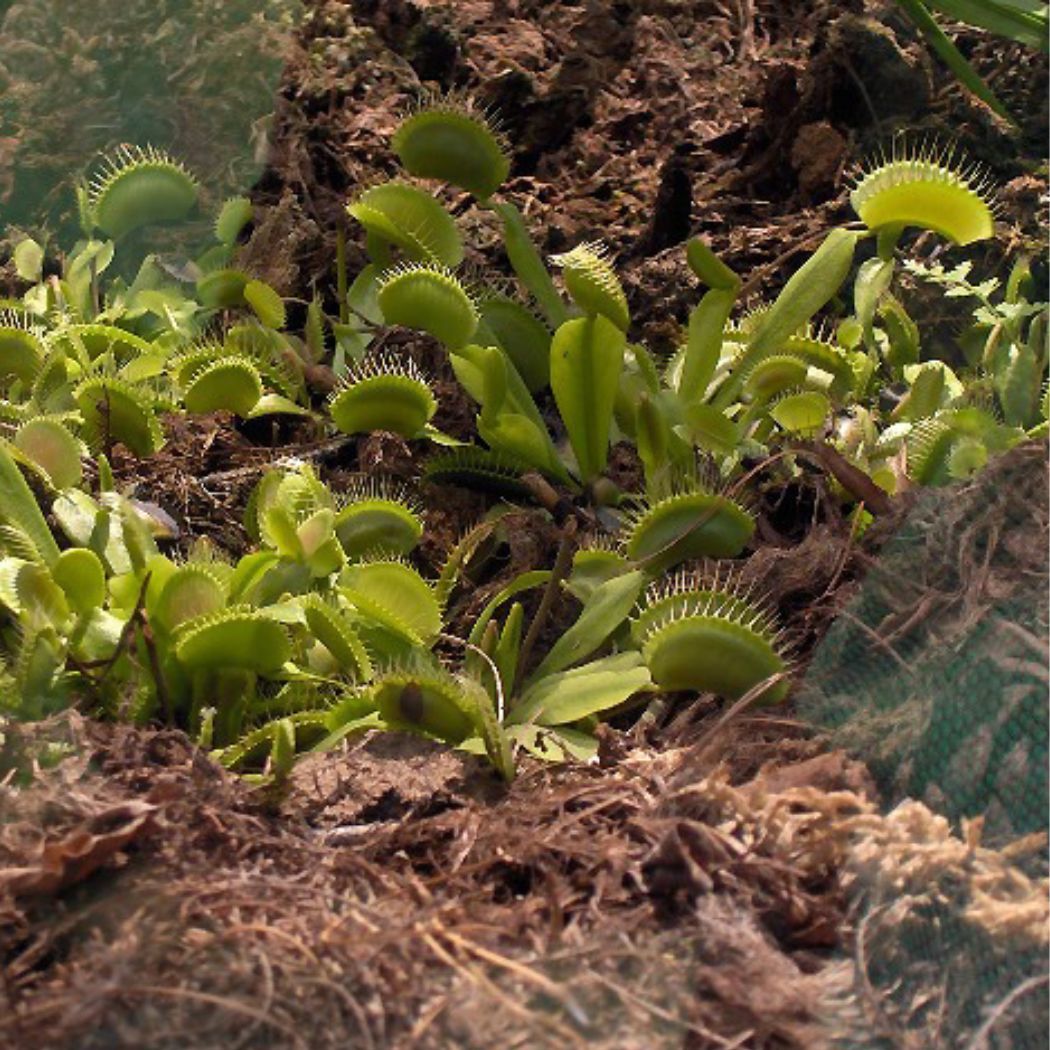


Sarkophyto - Dionaea Muscipula in a pot 8,5cm
- Leaves: Evergreen
- Water needs: Watery
- Needs for light: Direct exposure to the sun
- Flower pot size: 8 cm
- Plant height: 1 cm - 5 cm
- Durability over time: Perennial


Product description
Latin name: Dionaea muscipula
A few words:
The Dionaea, or Venus flytrap, is perhaps the most popular carnivorous plant. It belongs to the family Droseraceae and is the only species in the genus Dionaea, which makes it a truly special and evolutionarily specialized plant. The leaves end in traps whose inner surfaces are lined with sensitive trigger hairs. It is characterized by its distinctive leaf-traps that snap shut rapidly around insects and other small arthropods, which it then digests with special enzymes.
Dionaea muscipula is used almost exclusively as an ornamental and collector’s plant, particularly popular among people who love unusual or “weird” plants. Its carnivorous nature makes it an excellent educational tool for children and adults, as it impressively shows how a plant can adapt to nutrient-poor soils by obtaining nutrients from insects.
Although it does help “catch” a few insects in the area, it cannot be considered a serious method of disinfestation or pest control; its value is mainly aesthetic and educational.
Light and Water
Dionaea is a full-sun plant. In its natural habitat it is found in open sites with minimal shade, and to grow properly it needs at least 4–6 hours of direct sunlight per day, ideally even more.
Indoors, it prefers a very bright south- or west-facing window, where it receives direct sun. If it does not get enough light, the traps remain green, the red colour inside the traps fades, and the plant weakens overall.
As for water, Dionaea muscipula comes from permanently wet, boggy soils and needs the substrate to be always moist to very damp, never allowed to dry out. It is usually grown in a pot standing in a tray with 1–2 cm of water, so that the roots have constant access to moisture.
It is extremely sensitive to dissolved salts: use only rainwater, distilled water, or reverse osmosis water – never tap water with salts or chlorine.
Care Tips
For the substrate, Dionaea needs a very poor, acidic and well-aerated mix, without any fertilizers. A classic choice is sphagnum peat moss (or ready-made carnivorous plant soil) mixed approximately 1:1 with perlite or quartz sand, always without added fertilizers or compost.
Avoid any kind of “regular” potting soil or garden soil, because the nutrients and salts will damage its root system.
A critical point for its long-term survival is winter dormancy. In nature, Dionaea enters a resting phase from roughly November to February, with lower temperatures and shorter day length.
During this period, the traps blacken and the plant shrinks into a low rosette – it has not “died”, it is simply resting. If you grow it in a pot, in winter you can move it to a cooler spot (e.g. a cool room or a balcony without severe frosts), reduce watering so that the soil is just damp and not permanently waterlogged, and stop feeding it.
In spring it gradually returns to vigorous growth.
Temperature
In terms of temperature, this is a warm-loving perennial that enjoys hot summers but can also tolerate light frosts of short duration (down to about -5 °C, in some cases slightly lower).
In regions with very harsh winters, the pot needs protection (e.g. in a sheltered position, a greenhouse, or “fridge dormancy” as many growers practice).
Finally, it is good to remember that Dionaea prefers very good air circulation to avoid mold, especially in winter. If you see blackened traps, you can carefully remove them with clean scissors so that fungi do not grow on them.
Final tip – encouragement
For the average grower it is not the “easiest” plant, as it has specific requirements in terms of water, light and substrate; however, once these needs are met, Dionaea rewards you with spectacular traps and a truly unique presence in your collection.
Product photo may differ slightly from the actual plant.
Related products


